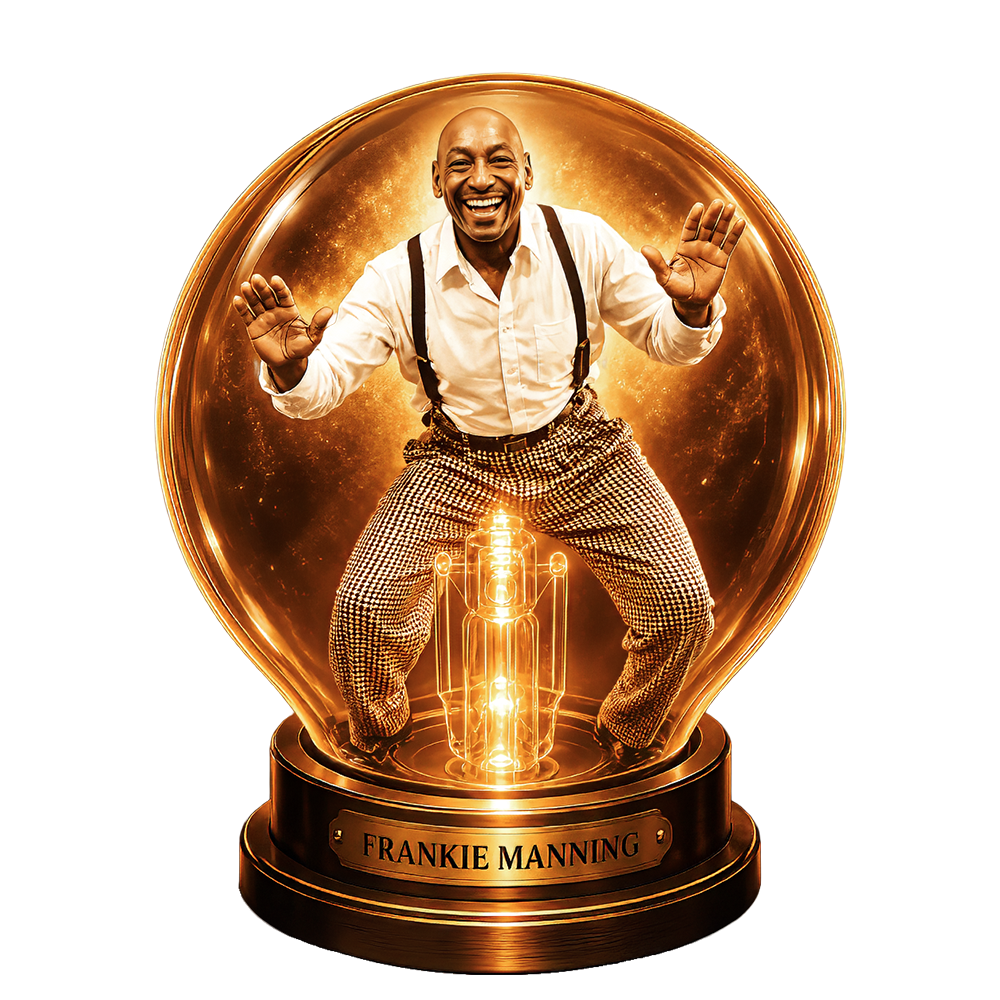
The Savoy Ballroom stood three thousand miles away, at 596 Lenox Avenue in Harlem — the block-long ballroom where a teenage furrier's apprentice who sneaked dance steps between fur cuts became the Lindy Hop's greatest innovator. When the Savoy closed on July 10, 1958, nothing was left to mark it, and for decades Frankie mourned that there wasn't even "a little piece of paper that says this is where the Savoy stood." The room Barbara Engelbrecht called "the 'soul' of a neighborhood" had become a housing development. Harlem finally answered on May 26, 2002, when a commemorative plaque was dedicated on Lenox Avenue — and Frankie himself was there to help unveil it.
This light carries that remembrance west. Starting now, every Wednesday night at 435 Broadway, ON Broadway and Cat's Corner fill this room with live music and swing dancing — the same ritual Frankie lived by: a band on the stage, dancers on the floor, each one pushing the other.
BRICKS & SWEAT: WHY IT MATTERS
Frankie's gift was hidden in plain sight: he could see a step once and mirror it on the spot. Herbert "Whitey" White saw it too, perusing the Savoy floor for recruits, and gave Frankie and the other Savoy dancers a standing invitation — come up during the day, rehearse, practice whatever you want. So they danced twice a day: afternoons with the rehearsing bands, nights with the crowds. That's how a ballroom becomes a soul — when the room belongs to the dancers even while the chairs are stacked.
It's also how the air step was born. Frankie and Frieda Washington — rooftop neighbors at 240 and 238, running across to each other's apartments — practiced day and night with no counts and no teacher, because no aerials had ever been done before. There was nobody to say "you go on five, six, seven, eight." They figured it out themselves. Then, on a packed Saturday night contest against Shorty Snowden's dancers, Frankie flipped Frieda over his back, she landed exactly as drummer Chick Webb hit the music — bam — and the Savoy Ballroom exploded. Everybody in the place stood up hollering.
Frankie always insisted the music and the dance were one conversation. Trumpeter Bill Dillard said you'd see a dancer hit a fantastic step and play a riff right along with it, add a little something — and watch the dancer add it right back. Or as Dizzy Gillespie put it: the dance enhanced. That interchange between bandstand and floor is exactly what returns to this room every Wednesday.